
Her father died in five minutes. She went from a woman who could not find her way two kilometres from home to standing at the United Nations with 24,000 global contacts.
Mumbai: Most students leave school with marks but without direction. They have demonstrated they can memorise, reproduce, and pass examinations. What they have not demonstrated — and what the system has not helped them discover — is who they actually are, what they are actually capable of, or what they actually want to build.
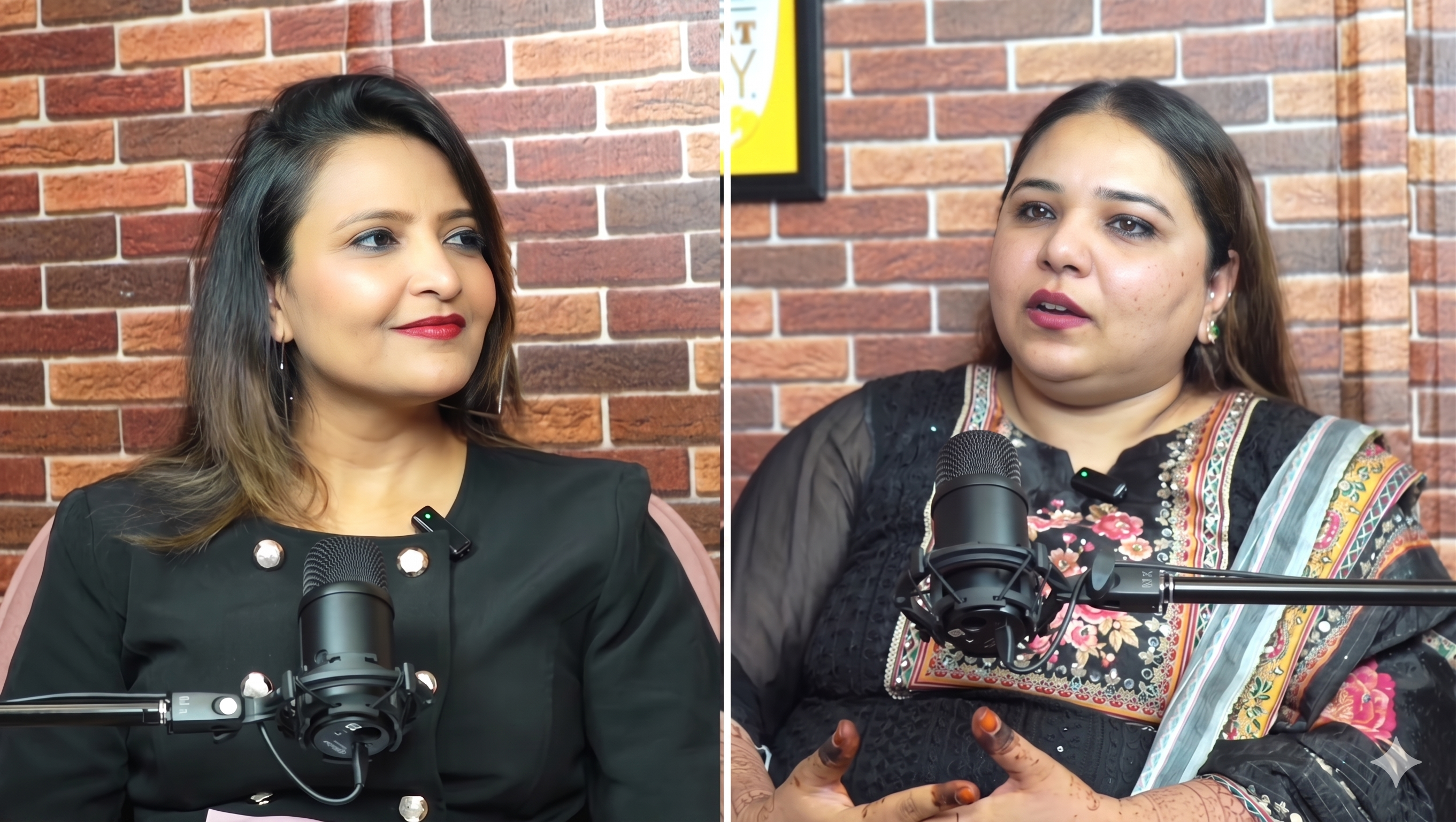
In a recent conversation on the Ek Soch Podcast with host Nirale Pandya, Dr. Uzma Charania — founder of Zedustation and a speaker at the United Nations on human rights and education — traced her journey from profound personal loss to building an education model that treats marks as an output of learning rather than as learning itself, and that treats global exposure as non-negotiable for genuine development.
"Her father died in five minutes. She went from a woman who could not find her way two kilometres from home to standing at the United Nations with 24,000 global contacts."
From Daddy's Princess to Self-Sufficiency
Dr. Uzma Charania's life before 2020 was structured entirely around dependence. She describes herself as a complete daddy's princess — someone so dependent on her father for navigation, decision-making, and confidence that she could get lost two kilometres from home. The dependency was not a failing. It was the natural output of a family structure that had arranged itself entirely around her father's presence and capability.
During the COVID pandemic, her father suffered sudden cardiac arrest. He died in five minutes.
The woman left behind was someone who had built no independent infrastructure of navigation, decision-making, or confidence. She had to build all of it simultaneously while processing the loss. The journey was not a triumph narrative. It was slow, fearful, and marked by self-doubt at every stage. She travelled solo to Portugal and the USA, crying at airports, moving through a world that suddenly felt vast and unmappable.
What she discovered through that process was not that she had hidden strength waiting to be revealed. It was that strength is built through repeated acts of moving forward despite fear — not through having the confidence first and then acting.
The Calling She Chose Over the Career
Before her father's death, Dr. Uzma was pursuing a Chartered Accountancy degree — a path her father had set, a career that carried status and security. But during her CA internship, she was secretly teaching junior students because teaching was what actually called to her.
When her father discovered what she was doing — sneaking away from her articled office work to teach — he did not respond with anger. He smiled. It was permission, finally, to pursue what she actually wanted rather than what was expected of her.
That experience shaped her conviction about what education should be: not a system that prepares students for paths that someone else has chosen, but a system that helps them discover what their own path actually is.
Why Education Is Misaligned, Not Failing
Dr. Uzma's diagnosis of the educational crisis is specific: the system is not failing. It is misaligned.
It is built around rote learning and good marks as the measure of success. It does not help students discover their true identity. It does not build real confidence — the kind that comes from knowing who you are and what you are capable of. It does not teach emotional intelligence, self-awareness, or the accountability that flows from genuinely understanding yourself.
The system produces marks. It does not produce self-sufficiency. And self-sufficiency, in Dr. Uzma's framing, is the actual purpose of education — the capacity to navigate a complex world, to understand yourself accurately, to build relationships on the basis of genuine self-knowledge rather than on the basis of seeking external validation.
Students arrive at adulthood with excellent marks and profound self-doubt, because the marks were never actually a measure of their readiness for the real challenge of being themselves.
What Global Exposure Actually Does
One of Dr. Uzma's most consistent arguments throughout the conversation concerns the necessity of global exposure — not as a luxury for privileged students, but as a structural requirement for genuine development.
Real development, she argues, happens through meeting different cultures, navigating different languages, interacting with people whose reference points are entirely different from your own. These encounters widen the mindset in a way that classroom learning cannot. They teach you who you are as an individual — not in the abstract, but in the concrete reality of being the foreign person, the different person, in a room full of people who do not share your assumptions.
Global exposure also builds real networks — connections with people across countries, across industries, across perspectives, that shape what becomes possible in a career and in a life. The 24,000 contacts Dr. Uzma now carries globally are the outcome of repeatedly placing herself in international spaces despite her own self-doubt.
The Missing Piece: Emotional Intelligence
Dr. Uzma identifies emotional intelligence — specifically, self-awareness — as the most significant gap in formal education.
Self-awareness is not taught. Accountability for your own emotional state, your own patterns, your own role in the dynamics you experience — these are assumed to develop somehow without deliberate teaching. The result is adults who are excellent at producing good marks but poor at understanding themselves, managing their relationships, or building the kind of internal foundation that allows them to make decisions that are actually aligned with who they are.
The gap compounds across a lifetime. Poor self-awareness damages professional relationships, personal relationships, and the capacity to make career decisions that are actually fulfilling rather than simply following the path that was established by others.
What Zedustation Actually Offers
Zedustation, the organisation Dr. Uzma founded, is built around addressing the gaps that formal education does not fill. The services include academic coaching and homeschooling support, but also leadership training, diplomacy training, international conference representation, and what Dr. Uzma calls personality and skill development programs.
The name itself — Zedustation — carries her philosophy. A student suggested "Zenith," meaning reaching the top. She combined it with "Ze," meaning intelligence, and replaced "education" with "dustation" to make it distinctive. The company's purpose is to help students reach their zenith of intelligence — which includes, but goes far beyond, academic marks.
Homeschooling: What It Actually Is
Dr. Uzma addresses a misconception about homeschooling that causes many parents to dismiss it as an inferior option without understanding what it actually is.
Homeschooling, in the Zedustation model, is not a child sitting at home doing nothing. It is a structured, full-curriculum system that allows students to pursue additional passions — sports, arts, music, entrepreneurship — without the constraint of a fixed school schedule. Socialisation does not disappear. It shifts from the school environment to the environments where the student is actually pursuing their passion.
A student who is serious about tennis, for instance, can structure their academics to accommodate their training without compromising either. The social development happens on the tennis court, with their tennis community, in an environment that is actually shaping their future rather than in a school hallway with peers who may never matter to them professionally or personally.
Validation-Seeking and How to Stop
Dr. Uzma shares the story of a student who was objectively excellent — strong academic marks, high athletic achievement, multiple accomplishments — and yet sought constant validation from everyone around her. The student could not see herself accurately because she was entirely dependent on external mirrors to tell her who she was.
The intervention was not more praise. It was teaching the student to stop seeing herself through others' lenses and to start identifying herself from within. The transformation was not instantaneous. It required repeated sessions of building self-awareness, of identifying patterns of validation-seeking, and of practicing the discomfort of moving forward without external approval.
The key, Dr. Uzma argues, is to stop asking for permission and stop fearing judgment. Identify yourself. Know yourself. Then just do — without checking whether others approve.
What She Tells Parents
Dr. Uzma's message to parents challenges what has become the default definition of success in Indian families.
Success is not a good job plus good marks. Success is a child who knows who they are, understands what they want to build, and has the confidence to pursue it despite obstacles and despite what others think. A parent's role is not to impose a formula for success. It is to support the child's identity — to give them permission to explore their actual passions, and to provide an emotional push when the child is uncertain.
She emphasises that money and pre-built legacy can disappear in an instant — COVID proved that. What cannot be taken away is a strong sense of self, genuine confidence, and the skills to navigate adversity. These are the investments that matter for long-term resilience.
Speaking at the United Nations
Dr. Uzma shares her own experience of global exposure through her work as a speaker at the United Nations on human rights and education.
She almost did not apply. Self-doubt nearly stopped her from submitting. She interviewed poorly — by her own assessment. And then she was selected anyway. She stood at the UN Headquarters in New York with the Indian flag behind her, spoke about education and human rights to a global audience, and built contacts that have shaped her understanding of what is possible.
The irony is precise: the woman who could not find her way two kilometres from home now navigates global leadership spaces regularly. The change was not because she became more capable. It was because she repeatedly moved forward despite the doubt, repeatedly placed herself in spaces that felt beyond her reach, and repeatedly discovered that the doubt was not an accurate measure of her actual capability.
The Challenge to Education: Think Global
Dr. Uzma's final challenge to schools and educational institutions is to think globally. Schools should sponsor students for exchange programs. Schools should invite international speakers. Schools should bring global leadership platforms to India, not just talk about them as if they are aspirational distant concepts.
The students who will actually shape the future are the ones who have experienced global exposure early, who have built networks across countries, and who have learned that their perspective is neither the only perspective nor the correct one — it is simply their perspective, which can coexist with and learn from others.
One Line on What Education Actually Is
Dr. Uzma's final definition of education, stated simply: education is not just academics. It is your whole persona, your whole identity, and how you recognise yourself.
Everything else — the marks, the career, the status — flows from that foundation. Without it, even excellent marks are fragile and dependent on external validation.
Nirale Pandya
Entrepreneur | Podcaster
"I help businesses grow through strategic PR, Branding, Business Consultation, Social Media Management, Digital Marketing, and Podcasting."
📅 Book a One-to-One Business Consultation:
Schedule Your Session🔗 Connect With Me
Published: Apr 28, 2026 | Category: Podcast