
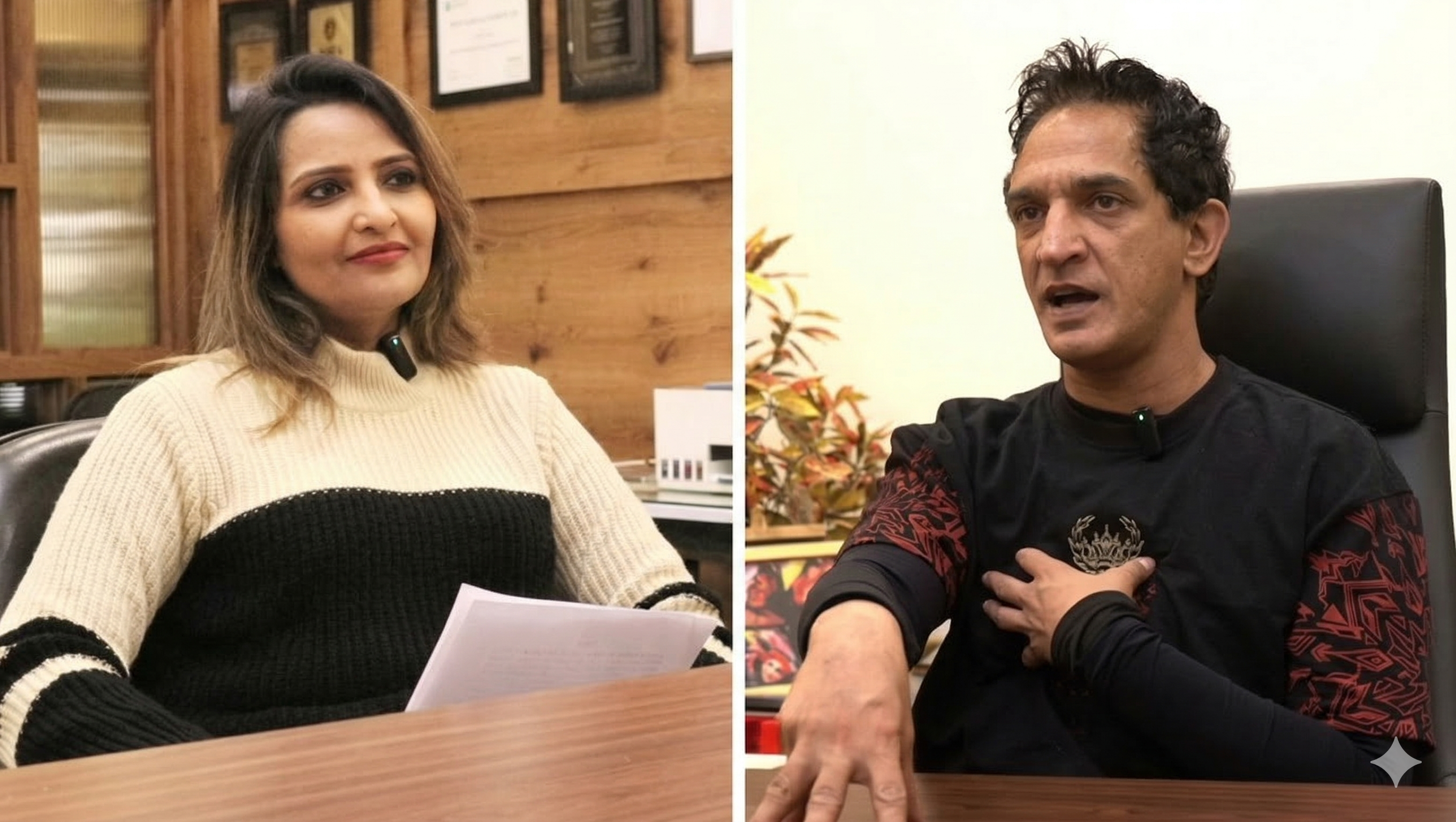
Ranjit Bajaj, founder of Minerva Football Academy, reveals why Indian football is broken and how to fix it — in a candid conversation on Ek Soch Podcast.
Ludhiana: Political speeches promise Indian football's rise every decade. Ranjit Bajaj is not making promises — he is building proof.
In a recent conversation on the Ek Soch Podcast with host Nirale Pandya, Bajaj — former India Under-19 player, Santosh Trophy veteran, and founder of Minerva Football Academy — laid out with striking clarity why Indian football has failed, what science says about fixing it, and why the revolution has already quietly begun in Punjab.
"How one man from Ludhiana is quietly building the team that will shock the world."
The Man Behind Minerva
Bajaj's connection to football runs three generations deep. Minerva Football Academy in Ludhiana was founded in 1955 by his grandfather, originally to produce officers for the Indian Armed Forces.
Today, it produces something equally disciplined: world-class Indian footballers. The academy operates as a fully residential campus — school, gym, swimming pool, psychology sessions, nutrition support, and football training all under one roof.
"This structure allows Minerva to achieve roughly 700 training hours per week, compared to a global average of around 300."
The Ecosystem Problem Nobody Talks About
India has 1.5 billion people. Yet historically, around 80% of the national football team has come from just six districts — parts of Kerala, Punjab, the Northeast, and Mumbai. Bajaj's explanation is direct: baby leagues, the structured grassroots competitions where young children first learn the game, exist in only five regions of the entire country.
The Indian Super League, despite its scale, operated for 15 years under a structure where clubs received no broadcast revenue. Each franchise was reportedly losing ₹30–35 crore per season. The result was predictable — clubs bought expensive foreign players instead of investing in youth academies.
"The original ISL clubs, across 15 years, have collectively produced fewer international players than Minerva Academy alone."
The Science of Age 8
Bajaj's most striking insight is biological. A protein called myelin, produced maximally between the ages of 4 and 13, is responsible for rapid skill acquisition — the rewiring of the brain that builds muscle memory, coordination, and instinct. Production drops sharply after 13 and is nearly zero by 18.
This is why Minerva insists children begin between the ages of 8 and 12. By the time most Indian children first seriously touch a football, their fastest developmental window is already narrowing.
"By the time most Indian children first seriously touch a football, their fastest developmental window is already narrowing."
The Results Are Already Here
In one year, Minerva's youth teams won all three of the world's biggest youth football tournaments — defeating teams from Argentina, Brazil, and Spain, including clubs like Barcelona. The Norwegian Indian Embassy recognised them as the first team in 50 years to achieve this.
- Won the Norway Cup, the Danmarkscup, and the Gothia Cup in Sweden in a single year
- Produced 248 international players across age groups in a decade — more than all original ISL clubs combined
- Anwar Ali from Adampur, Jalandhar (son of goat herders) is now the highest-paid Indian footballer at ₹4.8 crore per year
- Manisha Kalyan from Manipur became the first Indian woman to score against Brazil — and now plays professionally in Greece
The Neeraj Chopra Parallel
Bajaj draws a sharp comparison to athletics. Before Neeraj Chopra's Olympic gold, javelin barely existed in public imagination. After it, multiple Indians are throwing above 80 metres.
Indian football does not need a team result first. It needs one Indian playing regularly at the highest club level in Europe. That single moment, Bajaj argues, will shift what millions of Indian children believe is possible for themselves.
"India in the Top 8 in Asia by 2030, and qualified for the 2034 FIFA World Cup."
What He Tells Every Mother
Bajaj's most direct words in the conversation were aimed at mothers. He argues that mothers make the decisive call on whether a child pursues sport seriously, and his case goes beyond football.
Even if a child never turns professional, team sport builds what he describes as the qualities the Indian Armed Forces look for — discipline, leadership, resilience, and the ability to lose and recover. His advice:
- Start early — the developmental window closes faster than parents realise
- Let children play freely without excessive parental pressure
- Measure success in character, not just career
"Even if a child never turns professional, sport builds the exact qualities the Indian Armed Forces look for."
Nirale Pandya
Entrepreneur | Podcaster
"I help businesses grow through strategic PR, Branding, Business Consultation, Social Media Management, Digital Marketing, and Podcasting."
📅 Book a One-to-One Business Consultation:
Schedule Your Session🔗 Connect With Me
Published: Mar 11, 2026 | Category: Podcast