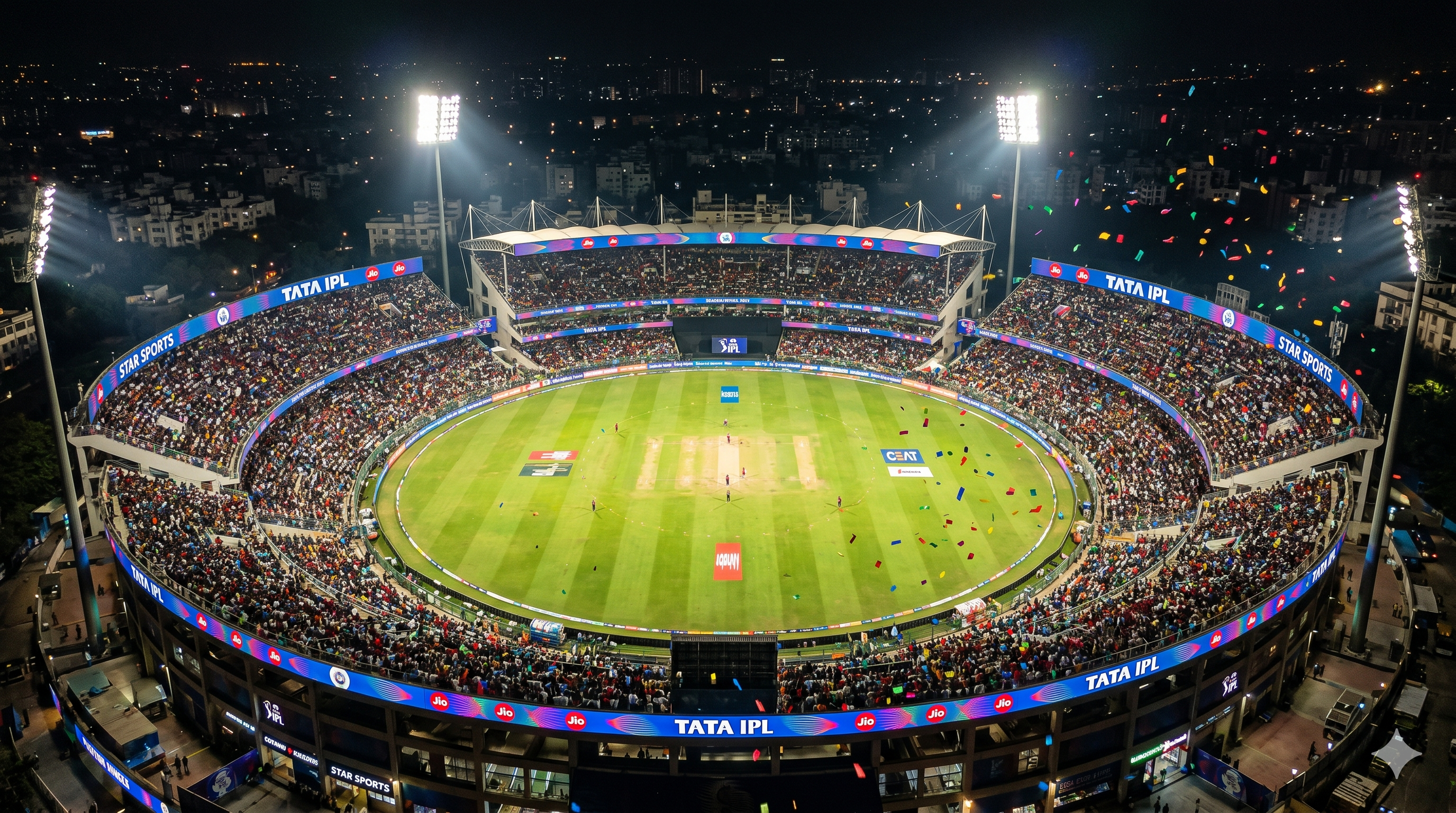
Every year, India stops. For 65 days, 1 billion+ people across every city, every town, every socioeconomic bracket lock in to watch twenty men chase a leather ball under floodlights. And every year, the smartest businesses in India use those 65 days to do in two months what would normally take two years.
If you are building a business in India and you are watching IPL only as a cricket fan — you are watching the wrong thing.
"Last season, brands spent over ₹7,000 crore on IPL advertising. Digital ad revenue alone is projected at over ₹5,000 crore."
The Numbers That Should Stop You Cold
Last season, brands spent over ₹7,000 crore on IPL advertising. This season, digital ad revenue alone is projected at ₹4,900–₹5,200 crore. Ad rates have surged 25–30% year-on-year. Over 425 brands advertised — including 270+ first-timers.
These are not vanity numbers. These are signals about where India's attention economy is heading — and every founder building a consumer brand, a D2C product, a SaaS tool, or a service business needs to read them correctly.
652 million viewers · 840 billion minutes watched · 40% increase in digital viewership year-on-year · 270+ first-time advertisers · IPL generates 15–20% of India's entire annual outdoor advertising revenue in just 65 days.
What IPL Actually Is: The Attention Funnel
IPL is the single most concentrated attention event in India. With 652 million viewers and 840 billion minutes watched, it has captured a 40% increase in digital viewership year-on-year.
In 65 days, IPL generates 15–20% of India's entire annual outdoor advertising revenue. One-fifth of the entire year's outdoor ad spend — compressed into two months. No other platform in India can buy you this kind of compressed scale. Not Meta. Not YouTube. Not any OTT platform.
- IPL reaches Tier 1 and Tier 2 cities simultaneously — a distribution miracle that most brands spend years trying to crack.
- The audience skews young, aspirational, and mobile-first — exactly the demographic every growth-stage D2C brand needs.
- Second-screen behaviour during matches means your digital ad reaches viewers who are already on their phones, ready to act.
The Shift: From Logo to Product Integration
Google's partnership with IPL 2026 is not a logo deal. It is a product integration deal — Google Search AI Mode is embedded into the viewing experience itself. This is the new model of sponsorship: not "put your logo where people look" but "embed your product into what people do while they watch."
Dream11 does not buy ad slots. It becomes the reason people watch with extra skin in the game. PhonePe does not run commercials. It becomes the transaction layer for everything IPL-adjacent. Jio does not advertise streaming — it is the streaming. The integration is the brand.
"The brands winning IPL 2026 are the ones that have become verbs during match time — not billboards."
The Franchise Model as Business Blueprint
Mumbai Indians is valued at $1.3–1.4 billion. RCB at $1.15–1.2 billion. These valuations are not built on cricket. They are built on community identity, consistent brand investment, and the monetisation of loyalty — year after year, whether the team wins or loses.
For anyone building a consumer brand, the IPL franchise model is a masterpiece proof-of-concept: Build identity. Generate emotion. Convert loyalty into revenue streams. The playbook works at any scale — you do not need a billion-dollar valuation to apply it. You need a community that cares.
You do not need to advertise on IPL to learn from it. Study which brands entered this year, how they positioned themselves, and what problem they were solving for a mass Indian audience. The 270+ first-timers are not just advertisers — they are a case study in how Indian consumer businesses choose to grow.
What This Means for You Right Now
Even if you cannot afford a JioCinema mid-roll or a stadium hoarding, IPL teaches you three things you can apply immediately:
- Attention is compressible. Find the single moment when your audience is most concentrated and be present there — even at a micro level.
- Integration beats interruption. The best brand plays are the ones that feel like part of the experience, not a break from it.
- Loyalty is built between seasons. The franchises that win long-term are the ones that stay present even when the tournament is not on.
IPL is not just a cricket tournament. It is a real-time masterclass in attention economics, community building, brand positioning, and the speed at which India moves when it decides to move. Watch it like a founder — and you will learn more in 65 days than any MBA programme will teach you in two years.