
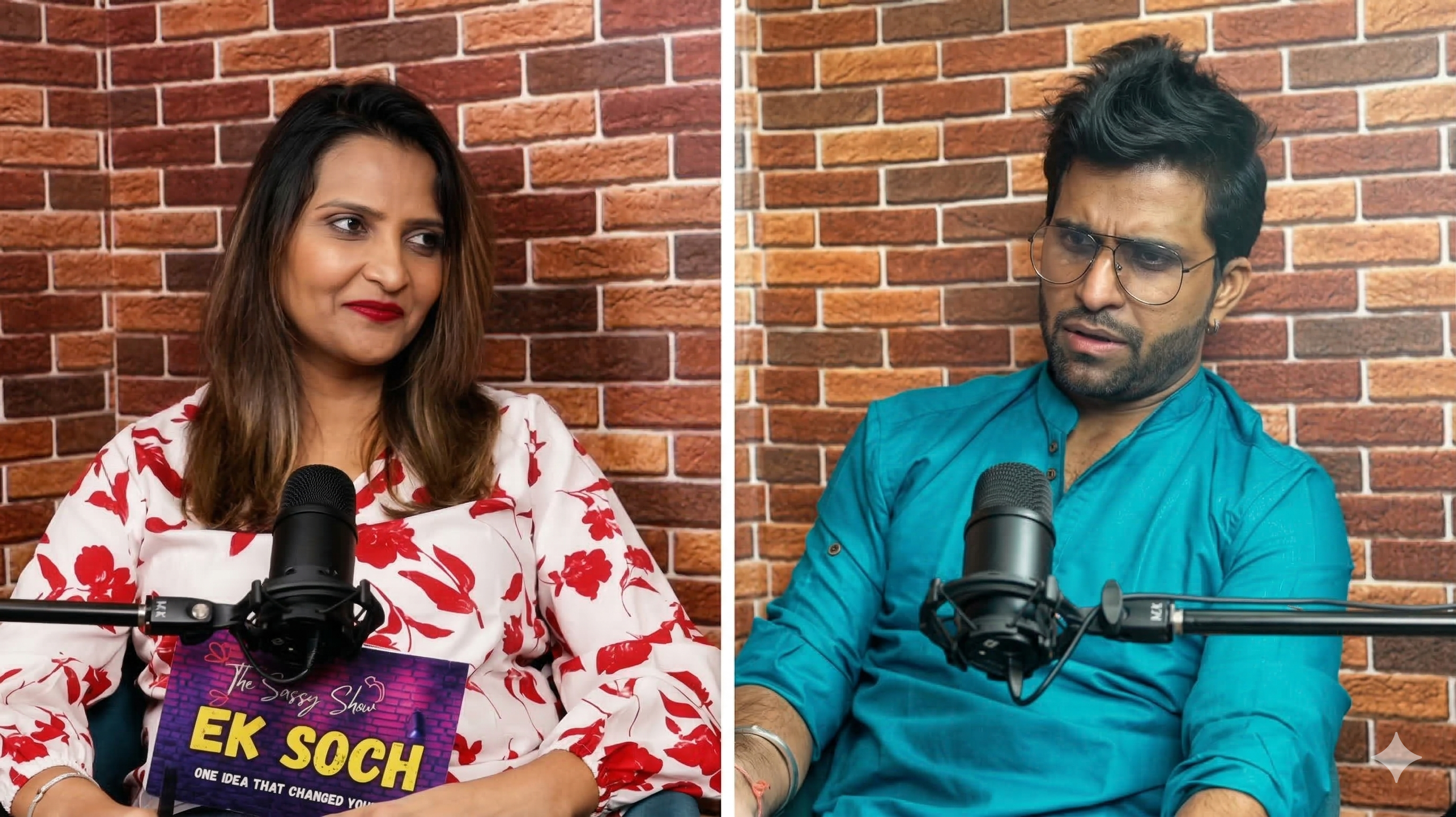
From 8 years of reality show rejections to Bollywood hits like Hookah Bar, playback singer Aaman Trikha shares his journey of craft, patience, and calling on Ek Soch Podcast.
Mumbai: Most people know the songs. Hookah Bar. Go Go Govinda. Son of Sardar. Very few know the name behind the voice — and almost nobody knows the eight years of silence that came before it.
In a recent conversation on the Ek Soch Podcast with host Nirale Pandya, Bollywood playback singer Aaman Trikha opened up about his journey from an engineering college in Mumbai to the recording studios of Hindi cinema — and everything that was endured, questioned, and held onto in between.
"Eight years of rejection, one recognition from Himesh Reshammiya, and a voice that Bollywood could not ignore forever."
Where the Voice First Appeared
Aaman Trikha did not begin his musical journey as a singer. During his engineering years at Thakur Engineering College, he played keyboard. Singing was incidental — something he did quietly, almost unconsciously, while working.
What he did not know was that classmates had started gathering outside the laboratory windows just to listen to him hum. That detail, small as it sounds, became the first signal.
"By the end of his second year of engineering, he already knew that singing was not a hobby he was pursuing — it was something that had already chosen him."
Eight Years of Getting Eliminated First
After graduating in 2008, Aaman began auditioning for the reality shows that defined that era of Indian music television — Indian Idol, Sa Re Ga Ma Pa, X Factor. He auditioned repeatedly, across years, with consistency that most people would not sustain past the first or second attempt.
He never made it past the preliminary rounds. The eliminations did not happen on television, in front of judges the country recognised. They happened quietly, in early rounds judged by local music teachers — rounds that never aired, never carried weight in public memory, but accumulated privately over nearly eight to nine years.
"He kept going anyway."
The Moment Everything Changed
The turning point came through the reality show Surakshkshetra, an India-Pakistan singing competition that featured Himesh Reshammiya, Atif Aslam, and Asha Bhosle as judges. What distinguished this moment from the previous decade of auditions was not just that he was selected — it was what Himesh Reshammiya observed about his voice specifically.
Himesh noted that Aaman's voice carried equal power in the studio and on a live stage — a quality, he said, that is rarer than most people assume in the industry. Back-to-back Bollywood songs followed. His first studio recording was Gore Mukhde Pe Zulfein Chhayi from the film Special 26.
"The career that had been building in silence for nearly a decade began, finally, to be heard."
What He Sees Happening to the Industry
Aaman's observations about the current state of Bollywood music are candid and specific. He points to several structural shifts worth noting:
- Film composition has shifted from one composer carrying the entire musical vision to multiple composers working on different songs within the same project — diluting artistic coherence and reducing playback singer visibility
- Audiences associate songs with the actors on screen, not the voices behind them — the singer's name disappears while the hero takes the cultural memory of the track
- Singers who rely on auto-tune to carry their performances are, in his words, not really singers — a betrayal of craft that Farah Khan has also made publicly
Patience in an Era That Has Forgotten It
Aaman draws a clear contrast between his generation's relationship with time and the one that has followed. His era meant arriving at audition venues at six in the morning and waiting in queues with no guarantee of being seen. The process was slow, unglamorous, and entirely without the feedback loop that social media now provides in seconds.
He does not dismiss the current generation. He recognises their intelligence and their ability to build audiences faster than any previous era of artists. But his concern is specific: an artist who compromises craft for money, for reach, or for the speed of a thirty-second reel has made a choice he is unwilling to make himself.
"He will not be treacherous to art even if it means earning less."
The Philosophy Behind the Journey
Running through the entire conversation is a single recurring idea — that a profession, at its deepest level, is not something a person selects. It is something that selects them.
Aaman reflects on the concept of inner calling, on the idea that transformation requires the old structure to break down before something new can be built, and on what he describes as the role of past-life karma in shaping present-life direction. These are not abstract ideas for him. They are the framework through which he makes sense of eight years of rejection followed by a career that eventually arrived exactly as he had believed it would.
"A calling is not chosen. It is answered — after everything else has failed to satisfy."
Nirale Pandya
Entrepreneur | Podcaster
"I help businesses grow through strategic PR, Branding, Business Consultation, Social Media Management, Digital Marketing, and Podcasting."
📅 Book a One-to-One Business Consultation:
Schedule Your Session🔗 Connect With Me
Published: Mar 18, 2026 | Category: Podcast